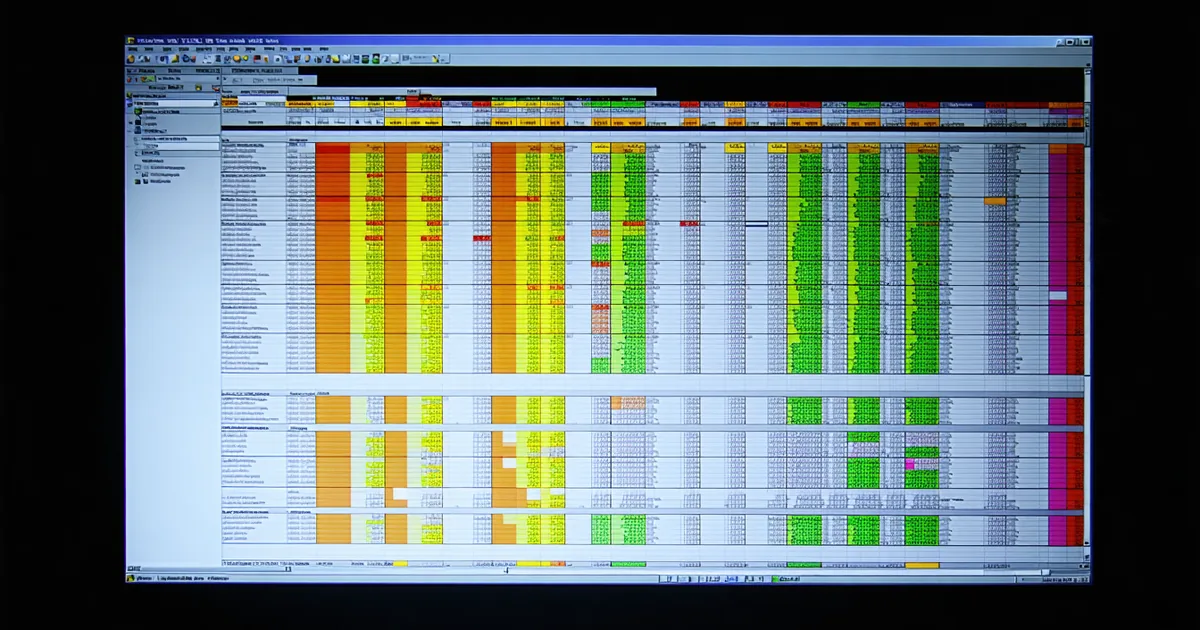
There is a predictable inflection point in TIC operations where the spreadsheet stops being a mild inconvenience and starts being a genuine liability. It tends to occur somewhere between 15 and 25 active auditors. Below that threshold, a skilled coordinator can hold the whole picture in their head — who holds which ISO 17021 competency, who is coming off a site visit in Stuttgart and can plausibly make a follow-up in Lyon, which auditors are restricted from a particular client due to impartiality rules. Above it, that mental model starts to fracture under its own weight.
This article is not a case against spreadsheets as a class of tool. Excel and its alternatives are extraordinarily capable for data analysis, financial modelling, and a hundred other workflows. The argument here is narrower: spreadsheet-based scheduling for mid-size auditor pools creates specific operational failure modes that compound as headcount grows — and those failure modes carry compliance consequences that go beyond missed appointments.
The Constraint Multiplication Problem
Scheduling a single auditor to a single job is trivial. You check availability, confirm the certification match, and send the assignment. The problem is that real-world audit scheduling involves constraint multiplication across every dimension simultaneously.
Consider what a coordinator must hold in view when filling a week's schedule for a 30-person auditor pool: each auditor has a certification profile (a mix of scheme-specific qualifications, surveillance and recertification audit authorisations, and technical competency areas), a geographic home base with associated travel limits, availability windows that account for annual leave, training days, and already-confirmed jobs, plus any impartiality flags that rule them out for specific client relationships. That is four constraint dimensions per person, across 30 people, against a job queue that may carry 20 to 40 active assignments at any point.
In a spreadsheet, each of these dimensions typically lives in a separate tab or a separate file. The coordinator mentally cross-references them on each assignment. That cross-referencing is where errors enter. A common failure pattern: the certification sheet is updated when an auditor passes a new scheme, but the scheduling master file pulls from a cached version. Or availability is confirmed via email, noted in one tab, but the booking is made from another. The spreadsheet contains accurate information — it just contains it in places that don't automatically talk to each other.
What Scale Actually Does to This Process
The failure modes above exist at any size. What scale does is change their frequency and consequence severity.
Take a plausible scenario at a growing certification body with 45 active auditors running roughly 60 audit-days per month across Western Europe. At this volume, a coordinator managing the schedule in a shared Excel file will typically encounter two or three of the following every week: an auditor double-booked because a last-minute job was added without checking the master calendar; a site visit confirmed for an auditor whose IATF 16949 lead auditor status lapsed three weeks prior; a geographic cluster that could be covered by a single auditor in two sequential visits instead being assigned as separate jobs to two different people — because the optimisation that would reveal that pattern requires comparing fields across two spreadsheets neither of which is sorted the same way.
None of these are human errors in the careless sense. They are structural outputs of a system where the number of constraint intersections has exceeded what manual cross-referencing can reliably handle. The coordinator doing this work is not making foolish mistakes — they are operating a system that has exceeded its design capacity.
The Impartiality Dimension
Certification scheme impartiality requirements add a particularly thorny layer that spreadsheet systems handle badly. Under ISO 17021-1, a certification body must ensure that auditors do not have relationships with the organisations they audit that could compromise objectivity. This typically manifests as auditor-client exclusion lists maintained by the CB's impartiality committee.
These exclusion lists need to be enforced at the point of scheduling assignment, not discovered after the fact. In a spreadsheet workflow, the exclusion list is usually a separate document — sometimes a formal register, sometimes a running email thread, sometimes a shared notes file — and checking it is a manual step that can be skipped under time pressure. At 15 auditors and 20 jobs per month, that step is easy to remember. At 50 auditors and 80 jobs per month, the step that gets dropped under deadline pressure is usually that one.
The consequence of an impartiality breach is not just a compliance finding during an IAF MLA peer review. It can result in the withdrawal of accreditation for specific schemes — a far more severe outcome than a rescheduling headache.
The Rescheduling Cascade
Manual scheduling also concentrates risk around change events. When an auditor cancels a day before a site visit, the coordinator must find a replacement who satisfies the same constraint set: same scheme certification, available on the same date, close enough geographically to reach the site, not on an impartiality exclusion for that client. In a spreadsheet system, this is a multi-tab search under time pressure — the worst conditions for catching constraint violations.
The cascade risk is that the replacement search is compressed, corners get cut on constraint verification, and the replacement assignment carries a higher error probability than original assignments. The first cancellation generates a second failure opportunity at elevated risk. Firms operating at scale see this pattern several times per month — each rescheduling event is a mini-crisis that consumes coordinator time and elevates error rate simultaneously.
What Good Looks Like at Scale
None of this is meant to suggest that TIC firms should tolerate their current scheduling pain indefinitely. The pattern we see across growing inspection operations is that the spreadsheet system works well enough to get the business to viability, and then becomes the ceiling that prevents it from growing further without adding disproportionate coordination headcount.
The right response is not to add another coordinator to manage the spreadsheet better. It is to build a system where constraints are encoded once and enforced automatically at the moment of assignment — so that impartiality checks, certification expiry, availability windows, and geographic clustering are not separate manual verification steps but conditions that the system will not let you violate.
This is a structural change to the scheduling process, not a productivity improvement. The goal is not to make the coordinator faster at the same task. The goal is to make the failure modes described above structurally impossible rather than merely unlikely.
The Staffing Arithmetic
There is also a simple staffing economics argument. When scheduling coordinators at growing certification bodies are asked how much of their week goes to scheduling and rescheduling, the typical answer is in the range of 40 to 60 percent. That is not time spent on value-generating coordination work — it is time spent on constraint-checking that could be automated.
At a 40-person auditor firm, if the scheduling coordinator is earning mid-range TIC operations pay and spending half their week on manual scheduling, the implicit cost of the manual process is substantial over a year — before accounting for the cost of the errors that process produces. Audits assigned to lapsed certifications require rescheduling; rescheduling has direct client relationship costs and, in some cases, accreditation implications.
The spreadsheet is not free. It carries hidden costs that grow nonlinearly with auditor pool size. Recognising that nonlinearity is the first step toward addressing it.